
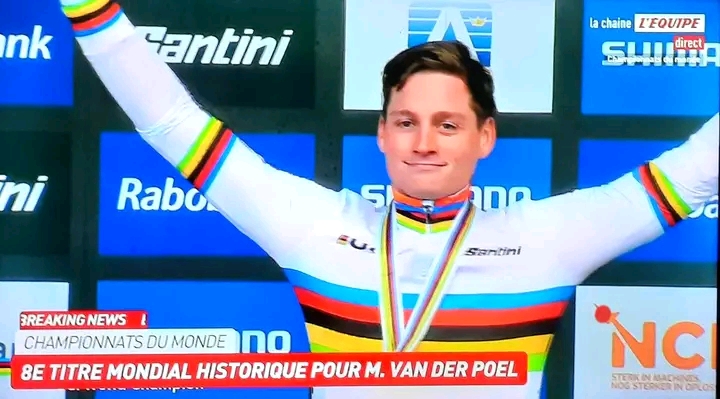
“Eight Times the King—And Still Hungry”: Mathieu van der Poel Rewrites Cyclo-Cross History at Hulst
History has a way of bending in the presence of greatness, but few moments in modern sport feel as seismic as what unfolded this weekend at Hulst in the Netherlands. On a course rutted with mud, churned by relentless wheels, and packed with spectators whose cheers echoed off the low winter sky, Mathieu van der Poel—already a cyclo-cross legend—did something no one had ever done: he won his eighth world cyclo-cross title, surpassing a record that had stood unchallenged for more than half a century.
For fans, analysts, and fellow competitors, the scene was almost surreal. There were moments in the race when it seemed the story might unfold in familiar ways—a challenge from Tibor del Grosso, the Dutchman’s fellow countryman, hinted at the possibility of an upset. Yet as the laps ticked by, Van der Poel asserted himself with the calm authority that has come to define him, opening gaps with measured bursts and refusing to allow even the smallest chance for doubt. Thirty-five seconds separated first and second by the finish line—a margin that, in cyclo-cross terms, can feel like a lifetime.
This wasn’t just a win. This was history being rewritten in real time. Eric de Vlaeminck, the Belgian legend whose seven world titles in the 1960s and 70s once seemed untouchable, finally had his record eclipsed. And the man who did it? A 31-year-old Dutch powerhouse who has spent years shaping a career around one unwavering goal: greatness.
—
The Rise of a Cyclo-Cross King
Mathieu van der Poel’s career has always been a study in inevitability. From the moment he first mounted a bike, it was clear that this was no ordinary talent. Cyclo-cross, road racing, gravel riding—he has approached each discipline not as a passing challenge, but as a canvas on which to demonstrate his unique combination of power, technique, and fearless aggression.
At Hulst, all these elements coalesced perfectly. The circuit was a test: slick with mud, lined with technical turns, and demanding in ways that separate champions from pretenders. Van der Poel handled it with the kind of precision that makes other competitors pause in awe. From the opening bell, he set the tone. Unlike some past champions who rely on bursts of late-race heroics, Van der Poel’s dominance was methodical, almost clinical. Each pedal stroke, each corner, each descent was executed with an awareness that only comes from years of perfecting the craft.
The crowd watched, mesmerized, as the Dutchman stretched his lead. Del Grosso chased valiantly, but the gaps kept widening. By the final lap, the question wasn’t who would win—it was by how much would history be made visible to the world. Thirty-five seconds later, Van der Poel crossed the line, arms raised, the weight of the moment settling in.
—
A Record That Once Felt Untouchable
For decades, Eric de Vlaeminck’s seven titles were almost mythical in status. Belgian cyclo-cross dominated the sport, and Vlaeminck’s name was spoken in the same reverent tones reserved for legends of any discipline. To surpass it required more than skill—it demanded resilience, an unerring sense of strategy, and a mind capable of enduring years of pressure without faltering. Van der Poel possesses all three.
Four consecutive wins, and eight titles overall, tell the story of an athlete who is not merely talented but almost preternaturally consistent. In a sport defined by variables—mud, rain, wind, snow, equipment failures, and the unpredictable chaos of rivals—Van der Poel has shown a level of command that is extraordinary even by elite standards.
“When I started, my absolute dream was to one day win the world championships at the elite level,” Van der Poel said after the race. “And here I am with eight titles. It’s simply extraordinary.” Those words, measured and almost understated, carried the weight of decades of effort, sacrifice, and ambition.
—
Hulst: Where Legends Are Forged
Cyclo-cross is a sport that punishes the slightest hesitation. Hulst was no exception. Tight corners, steep climbs, and sections of mud that could swallow a rider whole demanded absolute focus. A single mistake could mean the difference between a podium finish and obscurity. Van der Poel’s mastery over these conditions was evident in every lap. Where others stumbled, he accelerated. Where the course threatened to consume him, he adapted.
Fans, bundled against the winter chill, watched in disbelief. They had seen Van der Poel win before, but each victory seems to expand the boundaries of what they thought possible. The race became a showcase of not just speed, but intelligence, adaptability, and an almost imperceptible rhythm that separates elite athletes from the truly exceptional.
By the time the finish line approached, it was clear: history was being written, and Van der Poel was the author.
—
A Season of Unmatched Dominance
This world championship was the climax of a season that has seen Van der Poel achieve near-total dominance. He won the World Cup title, finishing first in all eight races he entered. A perfect season in any sport is rare; in cyclo-cross, it borders on the mythical. Every race presents new challenges—weather, terrain, competition—but Van der Poel has navigated them all with a consistency that seems almost impossible.
His record this season is not just about victories—it is about control. A rider capable of this level of performance is a rare phenomenon, one whose dominance forces a reconsideration of the sport’s history and its future.
—
Beyond Cyclo-Cross: A Multifaceted Champion
What sets Van der Poel apart is not just his cyclo-cross prowess. He has collected world titles in gravel racing and road racing, and boasts two Tour de France stage wins, each accompanied by a stint in the yellow jersey. Few athletes in any era have been able to move seamlessly across disciplines, translating technical skill into tactical brilliance and endurance.
Van der Poel’s versatility has made him a figure who transcends cyclo-cross. Fans who may not follow the sport closely recognize his name, his style, and his audacity. He is not merely a specialist in one niche; he is a universal rider, capable of bending multiple forms of cycling to his will.
—
The Shadow and the Light of Rivalry
Every era of greatness thrives on rivalry, and Van der Poel’s career is no exception. He has faced competitors determined to dethrone him, pushing him to the limits of endurance, technique, and strategy. Yet Hulst felt different. There was no shadow of doubt this time—no rival capable of denying the inevitable. For Van der Poel, this victory was less about competition and more about cementing his legacy.
At 31, he has moved beyond chasing history; he is shaping it. Each victory adds a new dimension to a career already defined by achievement, turning what once seemed like ambition into reality, and reality into legend.
—
What Lies Ahead?
The Hulst triumph, while monumental, is merely the latest chapter in Van der Poel’s story. The calendar ahead promises challenges as daunting as they are prestigious. In March, he will aim for a third Milan–San Remo victory, a race known for its strategic nuance and punishing distance. In April, he will chase a fourth Tour of Flanders win, seeking to break records that have stood for decades, followed by an attempt to equal the all-time Paris–Roubaix crown.
These are not casual ambitions. They are the apex of professional cycling—a gauntlet that demands peak performance, resilience, and daring. Van der Poel has proven time and again that he is not intimidated by such challenges. If anything, they seem to invigorate him, propelling him toward feats that redefine the sport’s landscape.
—
“Simply Extraordinary”—And Yet Routine
Perhaps the most remarkable aspect of Van der Poel’s achievement is the ease with which he carries it. His eighth world title is monumental, yet there is a sense of normalcy in how he approached it. No theatrics. No frantic energy. Just precise execution, calm determination, and an unshakable focus on the task at hand.
For spectators and competitors alike, that calm is disarming. It reveals an athlete who has internalized mastery so deeply that greatness has become routine. And perhaps that is the most extraordinary part of all.
—
Dutch Domination in the Women’s Race
Cyclo-cross at Hulst was not just about one man. The women’s world championship offered a complementary story of dominance, depth, and resilience. Lucinda Brand emerged victorious after a dramatic race that saw her recover from a late fall to claim first place. Her compatriots, Ceylin Alvarado and Puck Pieterse, completed a clean Dutch sweep of the podium, reaffirming the nation’s supremacy in the sport.
Brand’s win, especially coming after her fall, was a testament to grit, skill, and determination. The Netherlands has not just produced champions; it has created dynasties, and the women’s podium at Hulst reinforced that reality.
—
A Moment That Will Echo Through Cycling History
Hulst will be remembered for generations as the place where a record stood for decades—and finally fell. A place where Mathieu van der Poel, already a legend, elevated himself into the pantheon of all-time greats. Eight world titles. Four consecutive wins. A flawless season. And the promise of more records on the horizon.
In cyclo-cross, history is measured in mud, laps, and seconds. At Hulst, history was measured in legacy, ambition, and the audacity of a single athlete to redefine what the sport could be. Van der Poel has not just set records—he has set a standard, one that will echo for decades and inspire the next generation of cyclists to dream bigger, push harder, and ride faster.
And for those who witnessed it live, one truth is undeniable: Mathieu van der Poel is not just a champion. He is history in motion.