
“IT’S HARD TO WIN HERE” — DUKE DIGS DEEP, LEANS INTO ITS EDGE, AND SURVIVES CASSSELL
Cassell Coliseum has a memory.
A long one.
And for Duke, it hasn’t always been kind.
Over the years, some of the most talented Blue Devil teams — squads powered by stars like Kyle Singler, Marvin Bagley III and RJ Barrett — walked into this building with confidence and walked out humbled. The noise, the hostility, the way momentum seems to tilt with every made shot in Blacksburg has undone even the best.
So when Duke returned once again, head coach Jon Scheyer knew exactly what kind of night it would be.
“Playing here, and how difficult it’s been for us through the years,” Scheyer said afterward, “a ton of respect for Virginia Tech.”
Respect, yes.
But fear? Not tonight.
Duke leaned into something deeper than shooting rhythm or highlight plays. When the threes refused to fall and the crowd smelled blood, the Blue Devils leaned on competitiveness — the kind that doesn’t show up neatly in a box score but decides games like this.
Early on, Duke looked poised to break the Cassell curse with authority. A commanding 16-point lead late in the first half briefly silenced the building. But Cassell doesn’t stay quiet for long. Virginia Tech fed off its crowd, clawing back possession by possession, cutting the deficit to just six and threatening to flip the game entirely.
Amani Hansberry caught fire. Duke went cold.
And suddenly, the ghosts of past losses felt close again.
“Knowing they were going to have a great crowd advantage,” senior Maliq Brown said, “we had to create our own energy.”
That sentence became the night’s defining theme.
The numbers from beyond the arc were brutal. Duke finished 5-of-21 from three, including a painful 1-of-10 in the second half. Each miss seemed to fuel the Hokies, keeping them within striking distance even when Duke had chances to pull away.
But this Duke team didn’t panic. Instead, it turned inward — to defense, toughness, and the paint.
“Just trying to make them score over our size and length,” Scheyer said, outlining a defensive plan that became increasingly suffocating as the game wore on.
Outside of Hansberry’s standout performance, Virginia Tech simply couldn’t buy a perimeter bucket. The Hokies finished just 3-of-21 from deep, with Neoklis Avdalas, Ben Hammond and Jailen Bedford repeatedly swallowed up by Duke’s relentless backcourt pressure.
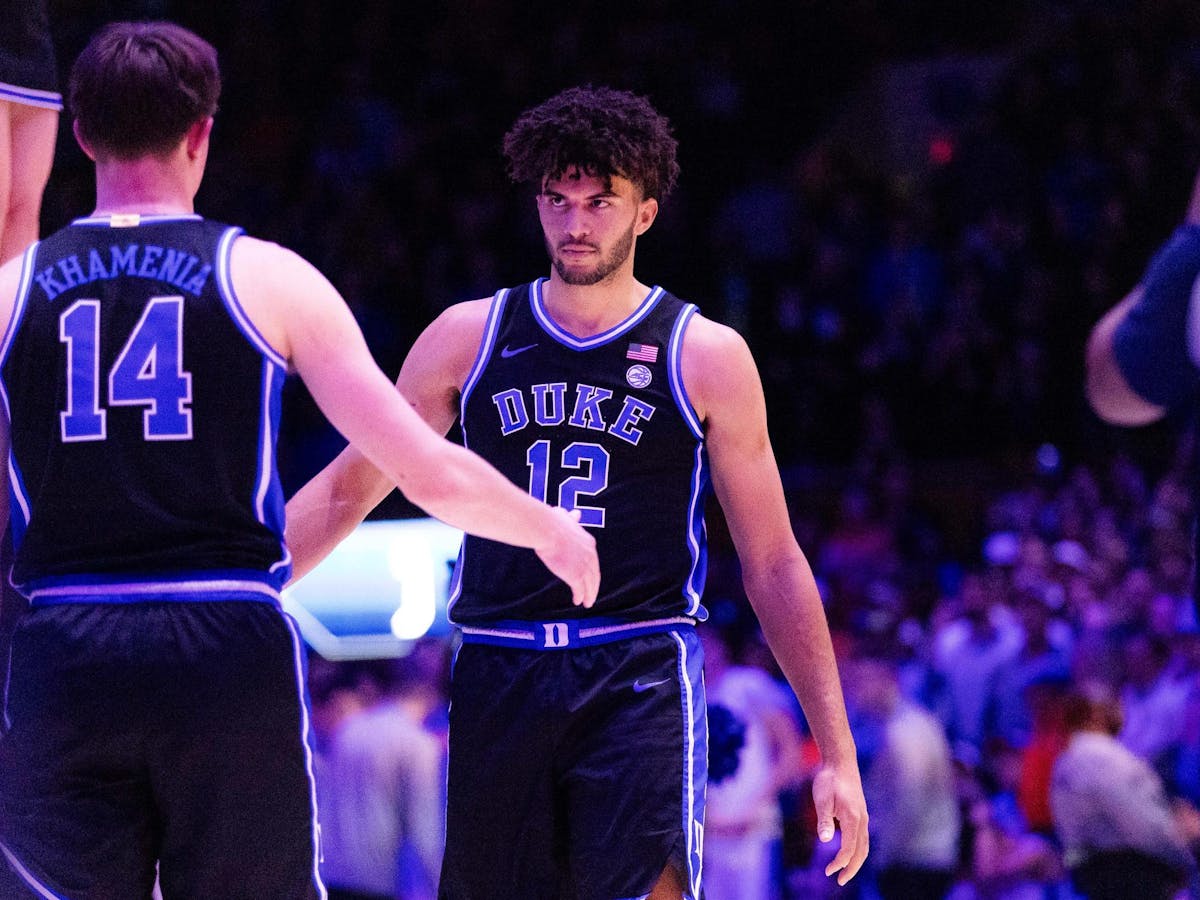
Dame Sarr, Nikolas Khamenia and Cayden Boozer didn’t light up the scoreboard — far from it. The trio combined for just eight points and didn’t hit a single three. On a night where offense was scarce, that could have been disastrous.
Instead, they leaned into their defense.
“[Sarr] just tried to will it and give us whatever he could,” Scheyer said. “I thought Nik and Cayden really stepped up.”
Their impact wasn’t flashy. It was physical, positional, and disciplined — the kind of work that frustrates shooters and drains energy from a home crowd desperate for a spark.
But the true backbone of Duke’s victory lived inside.
“We have a three-headed monster in Cam Boozer, Maliq Brown and Pat [Ngongba II],” Scheyer said. “Those guys are big-time competitors. They’re really smart. They’re tough. And they establish a competitiveness for our team.”
That competitiveness showed up in the paint — everywhere.
Defensively, Duke’s frontcourt pushed Virginia Tech away from the rim, limiting the Hokies to just 24 points in the paint and forcing most two-point attempts to come from an average distance of 8.4 feet. High-percentage looks were rare. Easy finishes disappeared.
Offensively, Duke flipped the script.
The Blue Devils poured in 46 points in the paint, feasting on efficiency when perimeter shooting failed them. Cameron Boozer was surgical, going 7-of-9 on two-point attempts. Ngongba added 3-of-5, while Brown chipped in an assertive 4-of-6.
Every basket near the rim felt like a release valve — pressure off the offense, air out of the crowd.
Brown described his mindset simply.
“Being aggressive and trusting my work,” he said. “Listening to Coach Carrawell on how to be aggressive. Taking my shots and being ready for the game.”
Then there was Caleb Foster.
The junior guard entered the day with uncertainty swirling around his availability due to illness. Cassell is not a forgiving place to test your stamina. Foster played anyway — because that’s what competitors do.
“I felt he was going to play all along,” Scheyer said. “That’s his mindset as a junior in our program.”
Foster didn’t dominate the stat sheet, but his fingerprints were everywhere. Three offensive rebounds. Loose balls. Calm possessions when chaos threatened. He steadied Duke when the game begged for composure.
In hostile environments, talent alone isn’t enough. Bright lights and roaring crowds can rattle even the best teams. What separates contenders from casualties is stability — knowing who you are when the game turns ugly.
Duke wasn’t perfect. The shooting struggles were real. The momentum swings were uncomfortable. But the Blue Devils never lost their identity.
They defended.
They fought.
They trusted their interior strength.
And when the final horn sounded, they walked out of Cassell with something many Duke teams before them couldn’t claim — a hard-earned conference win.
“To get a win here,” Scheyer said, “and to get our ninth conference win in January, really proud of our team.”
In a building that remembers every Duke stumble, this one will be remembered differently — as the night Duke didn’t blink.