
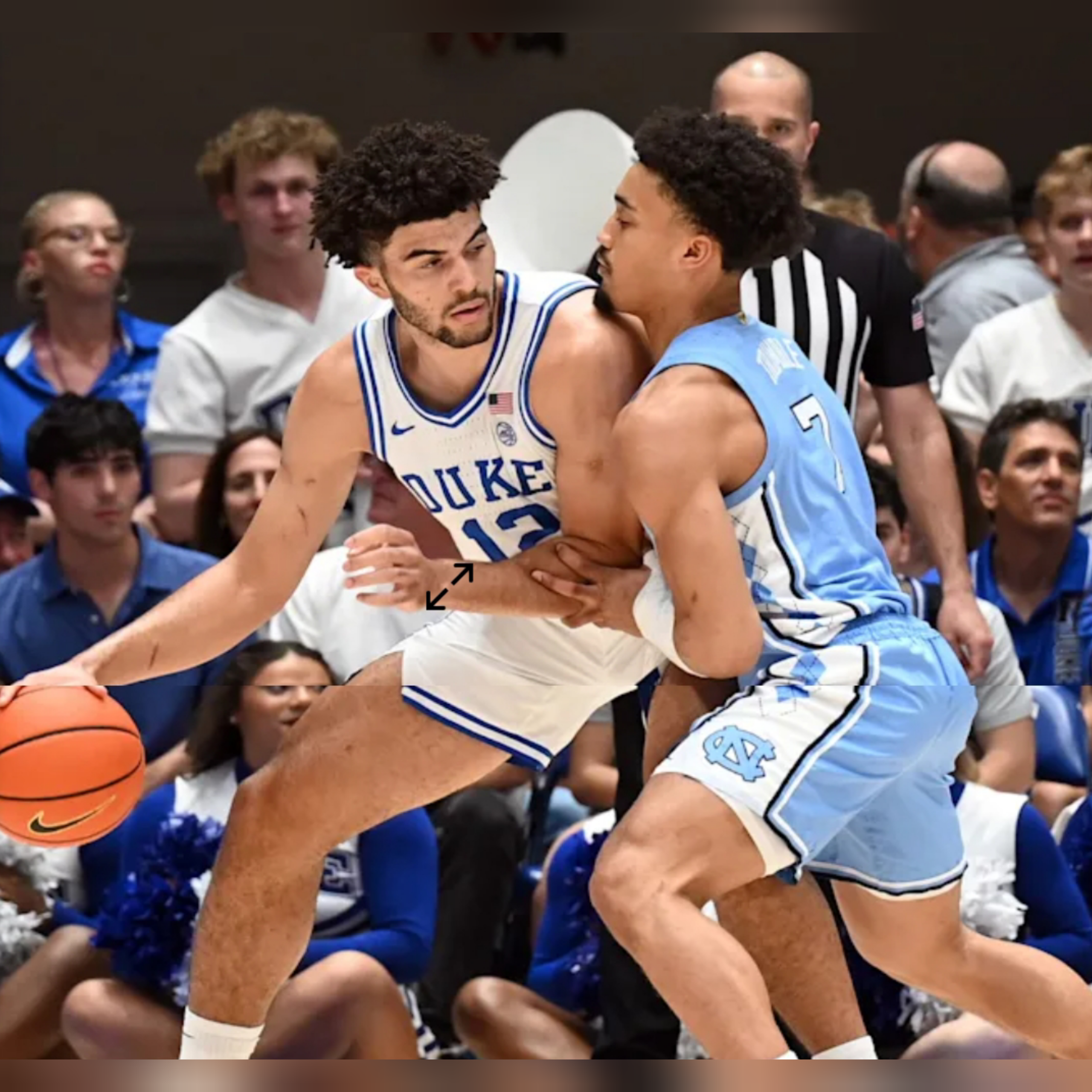
The North Carolina Tar Heels closed out their regular season with a challenging matchup against the Duke Blue Devils, entering the game as significant underdogs. The team was listed as an 18.5-point underdog before tip-off, largely due to the absence of one of their key players, Caleb Wilson, who suffered an injury that will keep him sidelined for the remainder of the season.
Despite missing such an important piece of their lineup, North Carolina managed to stay competitive during the early stages of the contest. By halftime, the Tar Heels were trailing by only five points, which many observers considered an encouraging sign given the circumstances. Early in the second half, they even had possession of the ball while down by just a single point, with the score sitting at 41-40. At that moment, it appeared that UNC might be able to keep the game close or potentially challenge Duke for the win.
However, the momentum quickly shifted in Duke’s favor.
The Blue Devils suddenly surged ahead with a dominant stretch that completely changed the course of the game. Duke launched an overwhelming 24-2 run, seizing full control of the matchup and creating a comfortable lead that North Carolina could not overcome. From that point onward, the Blue Devils dictated the tempo and dominated play on both ends of the court, eventually securing a 76-61 victory.
Following the loss, UNC forward Henri Veesaar did not hold back when reflecting on the team’s performance. Speaking candidly about how the game unfolded, Veesaar admitted that the Tar Heels failed to respond after Duke applied pressure.
According to him, once Duke began to assert itself physically and emotionally, North Carolina struggled to match that intensity. Instead of pushing back or fighting to regain momentum, the team allowed the situation to spiral.
“Once they went and kind of punched us, we didn’t fight back,” Veesaar explained after the game. “We just folded.”

His blunt assessment highlighted what many viewers saw during the second half: a North Carolina squad that struggled to maintain energy, composure, and competitiveness once Duke began its scoring run.
Another major factor in the Tar Heels’ defeat was their inability to compete on the boards. Rebounding proved to be a major weakness for UNC throughout the contest. Duke outperformed North Carolina significantly in this area, finishing with a 42-29 rebounding advantage. The Blue Devils were especially effective on the offensive glass, collecting 18 offensive rebounds, which allowed them to generate multiple second-chance opportunities.
These extra possessions often turned into points, further widening the gap between the two teams.
Two Duke players were particularly influential in this aspect of the game. Maliq Brown and Cameron Boozer consistently controlled the paint and gave North Carolina’s frontcourt significant trouble. The Tar Heels simply had no effective solution for their physicality and presence near the basket.
Boozer delivered an impressive offensive performance, finishing the night with 26 points, 15 rebounds, and five assists. His ability to score while also facilitating plays for teammates made him one of the most dangerous players on the court.
Yet, some analysts argued that Brown’s impact was just as important, if not more so. While Boozer produced eye-catching numbers offensively, Brown made life extremely difficult for the Tar Heels with his defensive intensity. By the end of the night, Brown had recorded 15 points, nine rebounds, two assists, five steals, and one block, while committing zero turnovers.
His defensive pressure disrupted North Carolina’s offensive rhythm throughout the game. Brown frequently intercepted passes, contested shots, and forced mistakes. The Tar Heels struggled to maintain possession of the ball, and Brown’s relentless defense played a significant role in that problem.
The absence of Duke players Caleb Foster and Patrick Ngongba might have seemed like an opportunity for North Carolina to exploit weaknesses in the Blue Devils’ lineup. Instead, Duke’s remaining players stepped up to fill those gaps effectively.
In the first half, North Carolina’s frontcourt showed some promise. Veesaar and Jarin Stevenson combined for 17 points and 12 rebounds, giving fans hope that they could hold their own against Duke’s interior players.
Unfortunately for the Tar Heels, that success did not continue after halftime.
During the second half, both Veesaar and Stevenson struggled significantly. Each player recorded just two points and three rebounds during the final 20 minutes of play. Veesaar also committed two turnovers, while Stevenson added one. Their sudden decline in production allowed Duke’s big men to dominate the paint without much resistance.
North Carolina also gave extended minutes to Zayden High, who managed to score a few points but had difficulty defending Boozer effectively. Boozer repeatedly found ways to score or create opportunities for his teammates, further exposing UNC’s defensive weaknesses inside.
Turnovers also played a major role in North Carolina’s downfall. The Tar Heels committed 14 turnovers, many of which directly resulted in points for Duke. In fact, the Blue Devils converted those mistakes into 24 points off turnovers, adding another layer to their offensive advantage.
The problem became especially evident during Duke’s decisive scoring run in the second half. Over roughly 11 minutes, UNC turned the ball over six times, allowing Duke to extend its lead and crush any momentum the Tar Heels had built earlier.
Interestingly, North Carolina actually shot the ball more efficiently than Duke in terms of field-goal percentage. However, that advantage meant little given the massive disparities in rebounding and turnovers.
By the end of the night, those two factors—losing the rebounding battle and giving up too many possessions—essentially sealed North Carolina’s fate.
Looking ahead, head coach Hubert Davis will need to address these issues quickly as the team prepares for the upcoming ACC Tournament. With postseason play approaching, every mistake becomes more costly.
For the Tar Heels, the path forward will require better ball security, stronger rebounding efforts, and more consistent performances from key players. Otherwise, their postseason journey could come to an early end.